Uniswap liquidity deposits create positions with specific pool settings and ownership records
A successful Uniswap liquidity deposit creates a position in the selected pool. The pair, protocol version, pool configuration and price range determine what the deposit contains and where it can earn fees. Before signing, compare the quoted token amounts with the intended range and confirm the selected network and exact asset identities.
A position is tied to one pool, not a generic liquidity balance. In concentrated-liquidity versions, it also records the price boundaries where its liquidity can participate in swaps.
Bottom line: A liquidity deposit becomes a position only when its transaction succeeds for the intended pair, pool configuration, applicable price range and token amounts.
The components of a first liquidity position
A first deposit combines a network, two exact asset identities, a protocol version, a pool configuration and deposited amounts. A v4 pool configuration includes a fee setting, tick spacing and a hook address; hook logic can change how the pool behaves. In v3 or v4, the position also carries lower and upper price boundaries. Each choice belongs to the position itself. Changing the fee setting, v4 tick spacing, v4 hook or price range changes the pool identity or the position's exposure.
| Parameter | Value recorded or applied | If it does not match |
|---|---|---|
| Selected network | The network that holds the pool and tokens | Assets elsewhere cannot fund this pool |
| Token identities | ERC-20 contract addresses or the native asset designation | A matching symbol can identify another token |
| Protocol version | v2, v3 or v4 position rules | Range and ownership assumptions may be wrong |
| Pool configuration | The fee setting plus v4 tick spacing and hook address | Another configuration identifies another pool |
| Price coverage | Full range on v2; custom or full range on v3 and v4 | A position outside a custom range supplies no active liquidity and earns no fees |
| Deposit composition | Pool ratio on v2; range math on v3 and v4 | A pool price move can change required amounts |
Token symbols do not establish asset identity. The wallet should show the intended network and exact identity of both assets before any approval or transfer. A position created in a different pool can still succeed onchain, even though it does not match the intended market.
Pool settings affect where capital works and which trades may pay fees. They do not promise traffic or returns. Volume, competing liquidity and time spent active all affect fee accrual after creation.
Price range controls where the deposit works
Price boundaries determine when concentrated liquidity participates in swaps. They also decide whether the initial deposit needs both assets or only one.
Uniswap v2 positions cover the full price range, while v3 and v4 can use either a custom range or the full range. Versions v3 and v4 express custom boundaries through ticks, which divide the price curve into usable intervals. The final lower and upper values remain attached to that position.
As swaps move the pool price through a custom range, the position's token composition changes. At or beyond a boundary, the position becomes entirely one token, apart from uncollected fees. It stops earning liquidity provider fees while the price remains outside the range. Its token balance remains exposed to later price movement even while inactive.
A narrow range concentrates capital across fewer prices, which can raise fee efficiency while the position stays active. It also reaches an inactive boundary sooner when price moves. A wider range covers more price movement but spreads the same capital more thinly. Neither choice fixes future fee income because swap volume and competing liquidity remain variable.
Why are the required token amounts uneven?
Required token amounts can differ because the current pool price and selected boundaries set the deposit ratio. A 50/50 split by token units is not the rule. For v3 and v4, an in-range position needs both pool tokens, while a range wholly outside the current price can be funded with one token. Entering one amount lets the position calculation derive the corresponding amount, subject to the chosen boundaries and current pool state.
For an established v2 pool, deposits follow the reserve ratio already in the pool. The first provider to an uninitialized pool instead establishes its starting ratio, so a mistaken initial price can expose the deposit to immediate arbitrage. Price display direction also matters: reversing which token quotes the other inverts the number without changing the underlying relationship.
Authorization and deposit create different onchain records
An ERC-20 approval gives a contract permission to transfer up to an allowed amount. It does not move assets into a pool or create a position. Some deposits need separate approvals for both tokens. The selected wallet also needs enough of the network's native asset for any transactions it must submit.
An approval can succeed while the later creation transaction fails or never gets submitted. Its receipt proves only that a spending allowance changed. Review the approved token, spender and amount before moving to the deposit transaction, since an unnecessary allowance can remain after an interrupted attempt.
After any required permissions exist, the creation transaction supplies assets to the selected pool under its quoted limits. An existing pool uses its current state to determine accepted amounts. An uninitialized pool also needs a starting price. That value deserves a separate comparison with the intended token relationship before any assets enter the pool.
The wallet confirmation should agree with the chosen network, token spending and expected contract action. Pool state may change between the displayed calculation and block inclusion. If the current token amounts fall outside the transaction's limits, the transaction can revert without creating a position, while the submitting wallet can still incur a network cost.
A successful creation transaction places the accepted assets into the pool and mints the relevant ownership record. If creation reverts, its state changes roll back and no position appears. Earlier approvals are separate records and remain until they are consumed, replaced or revoked.
How can you confirm that the position exists?
A successful creation receipt and a matching ownership record provide the strongest completion evidence. A wallet notification alone does not establish that the contract call succeeded. Open the transaction on the selected network, confirm its successful status and match the sending wallet with the address that now owns the position record.
The position details should then show the intended asset identities, protocol version, pool fee setting and price boundaries. Compare its deposited token amounts with the confirmed transaction rather than an earlier quote. The live composition may move after creation as swaps change the pool price, so a later balance does not need to equal the original deposit.
A delayed interface display does not justify creating the same position again. First determine whether the onchain ownership record already exists under the connected wallet and network. If the transaction succeeded in the wrong pool, the position is real but unintended. Correcting it requires removing liquidity and submitting another position transaction, each with its own network cost.
Ownership records determine who can manage liquidity
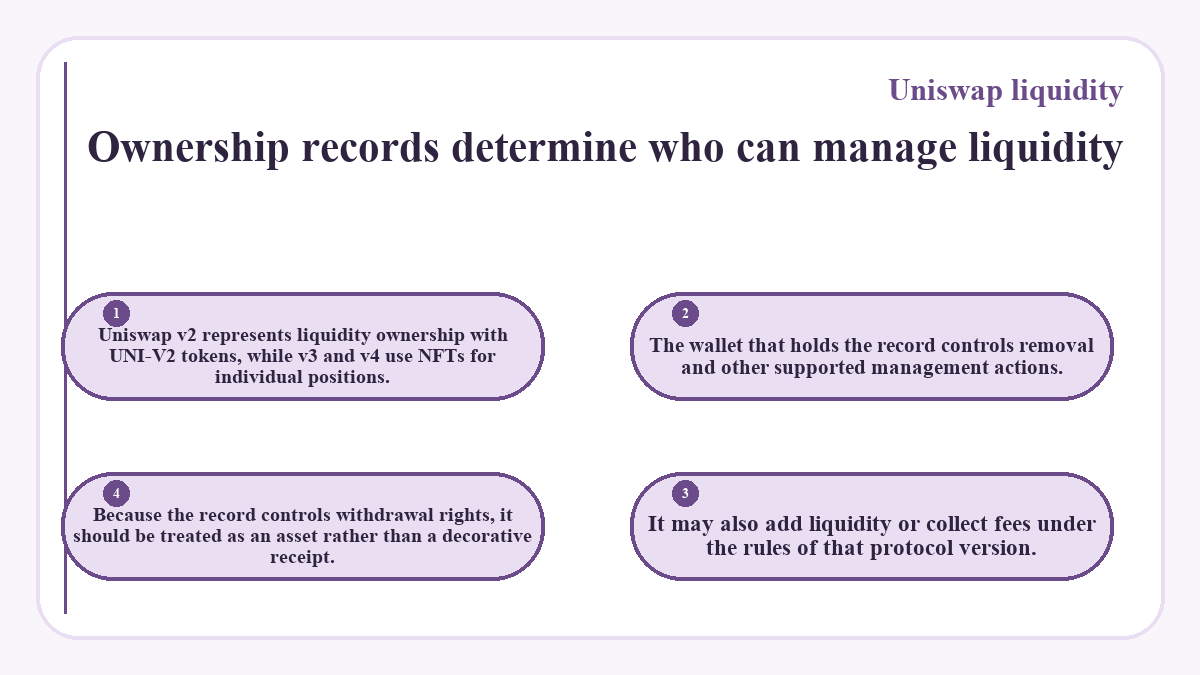
Uniswap v2 represents liquidity ownership with UNI-V2 tokens, while v3 and v4 use NFTs for individual positions. The wallet that holds the record controls removal and other supported management actions. It may also add liquidity or collect fees under the rules of that protocol version. Because the record controls withdrawal rights, it should be treated as an asset rather than a decorative receipt.
Wait before committing when inputs no longer agree
The reversible stopping point comes before wallet confirmation. Wait if the network, token contracts, pool configuration, boundaries or required amounts differ from the intended position. Changing an input should trigger a fresh calculation. Stop entirely when token identity or a new pool's starting price cannot be established with confidence.
Submitting commits the accepted assets and incurs network processing costs. Waiting leaves the wallet balances unchanged, preserves the option to revise the range and allows the pool quote to refresh. A pending transaction is different: once broadcast, do not duplicate it merely because an interface has not updated.
Fee accrual cannot remove the risks of token price changes, divergent performance against simply holding the assets or smart-contract failure. Concentrated positions add the chance of sitting outside their earning range. Continue only when the final wallet request matches the intended pool and affordable cost. If those inputs change before confirmation, wait for a new calculation instead.
Still wondering about Uniswap liquidity?
Will adding more assets create a second liquidity position?
Adding more assets can increase an existing position or create a second ownership record, depending on the selected action. Increasing a v3 or v4 position keeps that position's pool and price boundaries. Starting a new position mints another NFT, even if its settings match. Review the destination position before confirmation. Two positions can be economically similar, yet they remain separately managed because each NFT identifies its own liquidity record.
When must a price range be recreated?
Changing either boundary requires a new v3 or v4 position. The existing range cannot be edited in place, so the owner removes liquidity and creates a position with the desired boundaries. Removing liquidity makes the current token composition available for withdrawal. Earned fees may be collected in the same flow or through a separate action. Both removal and creation can incur network costs. Amounts available for the new position reflect the pool price when the old position is removed, not its original deposit ratio.
Is there an expiry date for a concentrated price range?
No. A concentrated price range is fixed for its position and does not expire on a date. The pool price may move outside the boundaries, leaving the position single-sided and unable to earn pool fees. If the price returns inside the same boundaries, liquidity becomes active again. The owner can leave it unchanged, add liquidity to that position or remove it and create another range.
Are full-range v3 and v4 positions the same as v2 positions?
No. Full-range v3 and v4 positions cover all possible pool prices, as v2 positions do, but their ownership and fee accounting differ. V2 issues fungible UNI-V2 tokens and keeps swap fees in pool reserves. V3 and v4 use NFTs for individual positions and accrue position fees for collection. Choosing full range removes the custom boundary decision. It does not convert newer protocol behavior or management actions into a v2 position.
Does opening a position move assets between networks?
No. Creating a position uses assets already held on the selected network; it does not bridge them from another chain. A matching symbol on two networks does not establish that they are the same asset. The wallet must hold the intended pair where the chosen pool exists, plus the network asset required for transaction costs. If assets sit elsewhere, moving them is a separate operation with its own route, risks and completion evidence before liquidity can be added.
Who controls a position after its ownership token is transferred?
The wallet that receives the UNI-V2 tokens or position NFT controls the associated liquidity. Transferring that ownership record gives the receiving wallet control over supported actions, including removing liquidity and collecting fees. Sending an NFT as if it were merely a picture can therefore surrender the position. A separate operator approval may also authorize another address to manage an NFT without transferring ownership, so ownership and permissions both deserve review.
At what point does an out-of-range position earn fees again?
An out-of-range concentrated position resumes active fee earning when the pool price returns inside its boundaries and swaps use that pool. The principal remains single-sided while the price stays outside, apart from any uncollected fees. As the price moves back through the interval, the active composition changes again. Re-entry does not restore an earlier economic outcome or guarantee enough trading volume to offset network costs, price divergence or time spent inactive.
Updated on