Uniswap fees and total swap cost comparisons
Uniswap fees form only one part of a swap's total cost. Compare quotes with the same input amount, input network, output asset, destination network and timing. Then account for the pool fee reflected in each route, any interface or token charge shown and the separate network cost. Convert every component into one reference unit before ranking the quotes. Treat price impact as execution quality rather than another fee, because adding it to the fee total would count the same loss twice.
In short: Compare final output, conditional approval costs and network charges before treating a lower pool fee as the cheaper route.
Cost components affect the comparison at different points
Separate value that reduces the quoted output from costs paid outside the swap. One percentage cannot describe both.
Pool fees reduce the routed amount
Each liquidity pool applies its fee to the amount entering that pool. Uniswap v2 uses a 0.3% fee, while v3 pools use defined tiers such as 0.01%, 0.05%, 0.3% and 1%. Uniswap v4 permits a wider set of fee configurations, including dynamic fees. The relevant figure is the fee attached to the quoted pool, not a version-wide assumption.
A final-output quote normally incorporates the route's pool fees. Record the displayed fee for transparency, but do not subtract it again when the quoted output already reflects it. Multiple pools can also charge fees in different token units, which makes simple percentage addition misleading.
Network costs sit outside pool pricing
Gas pays the network for processing approvals, swaps and other onchain actions. It changes with network conditions and transaction complexity. A route that uses several pools may require more computation than a direct route. The quote therefore needs both its estimated output and its estimated network charge.
An approval can create another network cost before the swap. Include it when the wallet must submit that approval for the route under comparison. A signature request without an onchain transaction does not create the same gas expense.
Quoted additions need separate labels
An interface, token contract, bridge or custom pool may introduce another charge. Keep each one under the name shown in the quote. This prevents an interface charge paid from output tokens from being confused with gas paid in a network token. It also exposes a cost that one route includes while another route does not.
Route structure changes fees and execution together
A direct route uses one pool, while a multi-hop route moves through intermediate pools. Each additional pool can introduce another pool fee and more onchain work. Deeper liquidity or a better exchange rate can still offset those costs, so fewer hops do not automatically mean a better quote.
Uniswap routing can split one swap across several liquidity paths. A split may reduce price impact by drawing from more liquidity, although it can make execution more complex. Compare the final output after route fees and then deduct the user-paid network cost in the same reference unit.
Two routes with different fee tiers should therefore be judged by net receipt, not by their lowest displayed percentage. A higher-fee pool with substantially deeper liquidity may return more output than a thinner low-fee pool. The quote captures that interaction at a particular moment.
A seven-stage comparison keeps quotes on equal terms
Normalize the task before comparing providers or routes. Changing the input, destination network or output token creates a different transaction rather than a cheaper version of the same one.
| Comparison stage | Comparison condition or record to preserve |
|---|---|
| Fix the intended outcome | Hold the input, output and destination network constant across quotes |
| Request fresh quotes | Record each quote time and collect them close together |
| Open the route details | Count every pool, hop and split path |
| Capture trading charges | Record every displayed pool, interface and token charge |
| Capture user-paid onchain transactions | Count each user-paid transaction required for approval, swapping, wrapping or bridging |
| Normalize the values | Use one reference unit and the same valuation snapshot |
| Refresh before commitment | Replace earlier estimates with the final quote |
The final row matters because pool balances and gas estimates can move while quotes are being compared. Preserve the earlier figures for comparison, but make the decision from a refreshed quote with the same endpoint.
One normalized calculation produces a comparable net receipt
Consider a hypothetical same-network swap that starts with 1.376 units of an unnamed input token. The route uses one Uniswap v2 pool. Its quote reports 2.416 output units after route execution, no separate interface or token charge and an estimated network cost equivalent to 0.026 output units.
Uniswap v2 applies a 0.3% fee to the input amount of every swap. The pool-fee calculation is 1.376 × 0.003, or 0.004128 input units. That leaves a fee-adjusted input of 1.371872 units for the swap calculation. The reported output already reflects that fee, so subtracting it again would double count it.
For comparison purposes, deduct the normalized network charge from the quoted output: 2.416 - 0.026 = 2.390 output units. Apply the same method to another quote and rank the net receipts. Keep price impact beside this figure rather than subtracting it a second time.
Nothing has been committed while these values remain quotes. Refresh both the output and gas estimate before submitting the swap transaction. If either figure changes, replace only that input and recalculate. The reader can abandon the route at that point without submitting the swap.
Price impact belongs beside cost, not inside the fee total
Price impact is the change in the pool price caused by the trade itself. It depends on the trade size and available liquidity along the route. A pool fee instead follows the fee rule attached to each pool.
The quoted output already reflects how the proposed trade interacts with pool liquidity. Adding the displayed price-impact percentage to pool fees would usually count part of the reduced output twice. Use price impact to judge execution quality and use normalized output to compare what each route delivers.
Slippage tolerance has a different purpose. It sets an execution boundary for movement after the quote rather than predicting a charge. Raising the tolerance does not lower the pool fee or repair poor price impact. It only permits execution across a wider output range.
The commitment point separates estimates from spent costs
A quote remains an estimate until the wallet submits a swap transaction or signs an order. A separately submitted approval can incur gas before that commitment. That boundary separates forecast costs from network charges that may already be spent.
Before submission
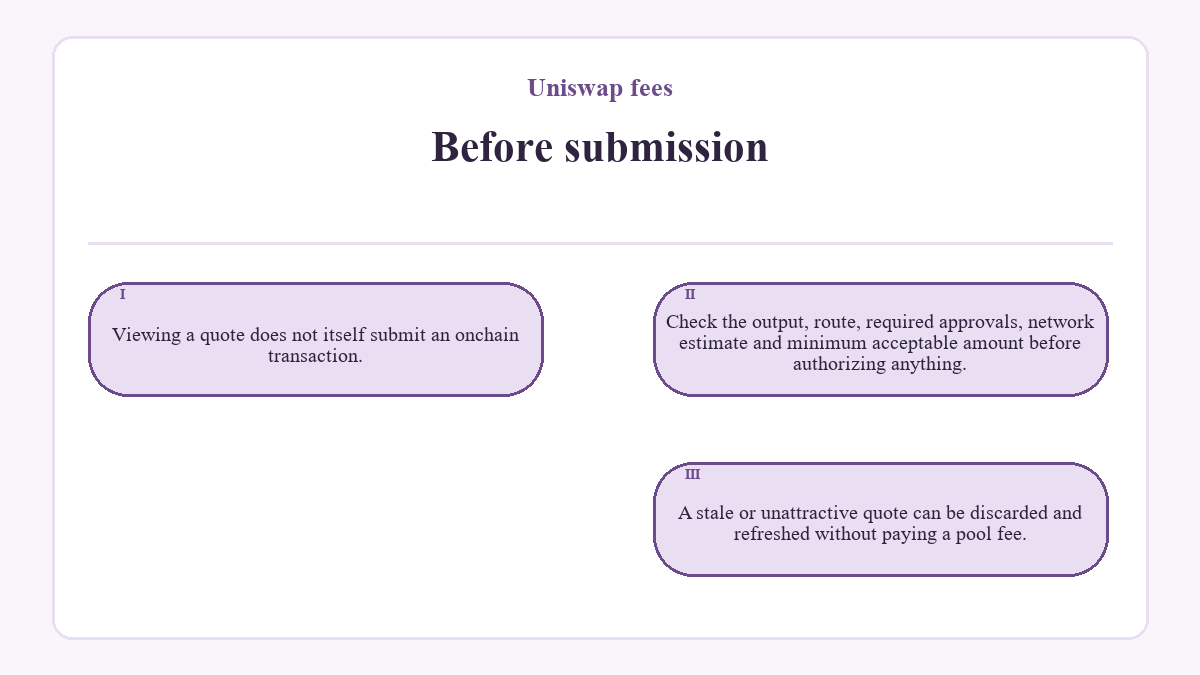
Viewing a quote does not itself submit an onchain transaction. Check the output, route, required approvals, network estimate and minimum acceptable amount before authorizing anything. A stale or unattractive quote can be discarded and refreshed without paying a pool fee.
If an approval appears, treat it as a separate decision. Confirm the token, spending amount and authorized contract. An approval transaction can incur gas even when the later swap never happens, so its cost belongs in the immediate comparison.
After submission
A direct onchain swap may consume gas even if it reverts because the network processed the transaction. The reverted call does not deliver output or retain its pool-state changes. Repeating the same transaction can spend more gas without fixing the cause.
Use the smallest reversible recovery step first. Refresh the quote and check whether a completed approval remains valid. Submit another approval only when the existing permission is missing or insufficient. This limits a route error to the fewest additional onchain actions.
Edge cases need their own cost lines
Some execution paths shift costs between components rather than removing them. The net receipt remains the common comparison point.
Prior permissions change first-use cost
A wallet with a suitable existing permission may avoid a new approval transaction. Another wallet may need one before reaching the same swap. Show the immediate total and a repeat-swap total separately instead of spreading one approval cost across an unknown number of future trades.
Alternative execution shifts who pays gas
With UniswapX, fillers submit orders onchain, pay the settlement gas and incorporate that expense into the offered price. The swapper may still pay for an initial onchain approval or for wrapping a native network token. Compare the offered output and those prerequisites with the output and gas from a direct pool route.
A crosschain quote adds a destination network and bridging step. Compare it with another quote only when both begin and end in the same states. Include the bridge charge and every user-paid network action shown for that path.
Token rules and custom pools add distinct charges
A fee-on-transfer token can charge when it moves, independently of the pool fee. Uniswap v3 and v4 do not support fee-on-transfer tokens, so a route through either version is incompatible rather than merely more expensive. Uniswap v4 hooks may also define pool-specific behavior, including fee logic. Keep these charges visible rather than folding them into a generic Uniswap rate.
The same principle applies to provider charges. Use the amount that reaches the intended destination after every quoted deduction. For example, an UniswapX order and a direct Uniswap v3 route can show different user-paid gas while competing to return the most output for the same input.
Still have questions?
Does lowering slippage tolerance reduce the Uniswap pool fee?
No. Slippage tolerance sets the minimum acceptable output or another execution boundary; it does not change the pool's fee setting. A tighter limit can make a moving quote more likely to revert, while a looser limit permits a wider execution range. Neither choice reduces the pool fee.
When should approval gas be included in a swap comparison?
Include approval gas when the swap cannot proceed without a new onchain permission. For a one-off comparison, add it to the immediate total. For repeated swaps, also show a separate repeat-cost view because an existing valid allowance can remove the approval transaction. An offchain signature, if required, does not add another network charge.
Why can a failed direct swap still consume network gas?
A direct onchain transaction can consume gas because the network processes it before the contract returns a failure. The pool-state change then reverts, but the computation has already used network resources. A quote rejected before broadcast does not create that onchain charge. These are different failure states.
Are fee-on-transfer token charges part of the pool fee?
No. A fee-on-transfer token applies its own contract rule when the token moves, while the pool charges its route fee separately. On a compatible route, the token charge can reduce the received amount and belongs on its own line. Uniswap v3 and v4 do not support fee-on-transfer tokens, so a route through either version should be treated as incompatible.
How should UniswapX quotes be compared with direct pool routes?
Compare UniswapX and direct pool routes using the same input amount, input network, output asset and destination network. A filler submits the UniswapX order onchain, pays the settlement gas and reflects that cost in its offered price. Initial onchain approval or native-token wrapping can still create a user-paid network charge.
When is a crosschain quote comparable with a same-network quote?
A crosschain quote is not directly comparable with a standalone same-network quote because they end on different networks. Compare the crosschain route with a same-network swap plus the required bridge only when both options start with the same asset and network and deliver the same destination asset and network. Include bridge charges, network costs and destination requirements.
Could a smaller swap have a higher cost percentage?
Yes. If two swaps face a similar absolute network charge, that charge consumes a larger share of the smaller input. Pool fees generally scale with the traded amount, while gas follows transaction work and network conditions. Compare both the absolute total and its percentage of the input.
Updated on